I hope you are well. Just to echo Jeff’s words, we appreciate our long-term partnership with SwissAfrican Foundation. Your support has a tangible impact on the important conservation work we do. I hope the attached report shows this.
All the best,
Andrew Malherbe - Chief Operating Officer
Rhino Rangers, Namibia
2025 - Rhino Rangers Namibia - donation of USD 15,000
The efforts of Rhino Rangers Namibia to monitor and protect the world’s last truly free-ranging black rhino population are very successful. Despite a challenging start to the year with the unexpected US government cut of just over 10% of planned income, 2025 incorporated several significant achievements to Save the Rhino Trust.
SRT exceeded three of four targets for 2025 in rhino monitoring with another massive year in foot kilometers and just missed their rhino sighting target (4331 to be precise) after a record-breaking year of over 5’000 sightings in 2024. With SRT’s COO obtaining the private pilot license in June, aerial patrols have been added to the mix of rhino monitoring tools. The patrolling teams clocked over 55’000 km on foot. Sadly, a confirmed poaching case was recorded where a breeding cow and her sub-adult calf were killed.
Eight staff members were sent to Southern Africa Wildlife College in Kruger Park. Training was split into Field Ranger Skills and the Braveheart Leadership Course.
After nearly 12 years of well below average rainfall across Namibia’s northwest, 2025 brought much needed above average rainfall to an almost barren landscape. All key population measures more than doubled in 2025 strongly suggesting that the good rains have already created a measurable and substantially positive impact on the rhino populations growth.
The two primary Rhino Pride Campaign initiatives, Rhino Cup Youth Champions League and Reading with Rhinos continued strong with a newly developed full six months league for the 11 Girls teams and reading programme with over 1’000 students.
First and foremost, overall, the efforts to monitor and protect the world’s last truly free-ranging population of black rhino were once again very successful with exceptional patrol effort. These indicators are on complete control of SRT and improving upon every year. SwissAfrican Foundation is firmly convinced of the importance of SRT’s pioneering work and has supported the organization since the beginning.
More success stories related to this project
Our partner
Jeff Muntifering - Save the Rhino Trust
Our local partner is the Save the Rhino Trust (SRT). This organisation has been working to protect rhinos in north-western Namibia for over thirty years, and it is largely thanks to their dedication that stocks have stabilised and recovered. The Save the Rhino Trust works closely with local communities, the Ministry of Environment (MET) and other non-governmental organisations (NGOs). Approximately 75% of SRT’s efforts are allocated to field patrolling and monitoring. Everything depends on this work: without accurate information about the rhino population’s performance trends, SRT cannot make decisions about regional tourism, Ecological Carrying Capacity, make recommendations to MET about the target animals to be translocated etc. Monitoring the rhinos continues to be the prime activity. Its long existence reflects an exceptional relationship of mutual trust between its partners, a highly successful commitment to the rhino, and a deep-rooted understanding of sustainable tourism in the region for the benefit of the animal world.
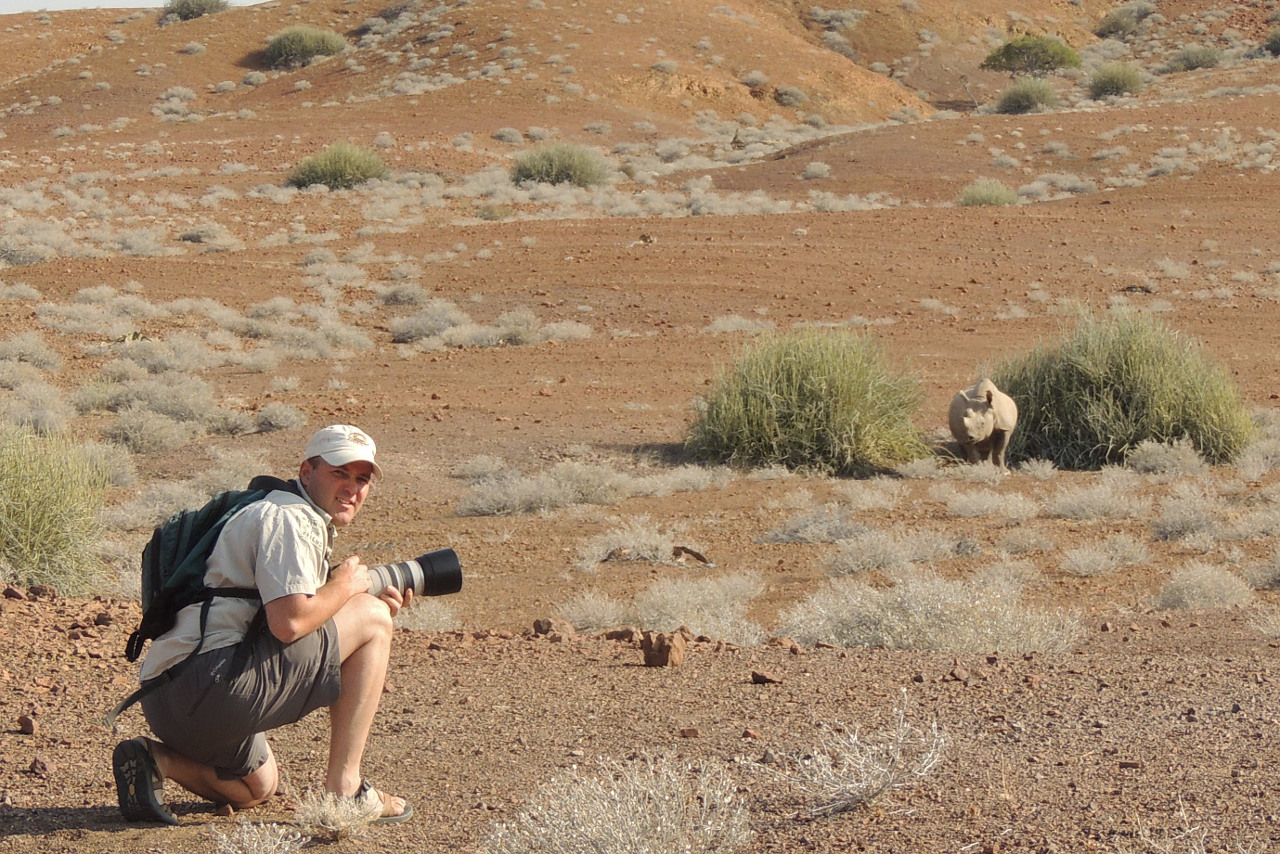
The organisation’s most important task is to monitor and observe the rhino. This scientific work offers essential insight into the rhino's way of life and forms the basis for the sustainable development of tourism and inclusion of the local community.
Born and raised in Minnesota (USA), Dr. Jeff Muntifering has spent the last 15 years of his professional career designing and delivering applied research, training and community-based programs to advance conservation practice while living and working out of remote field stations around the world. Currently, his time is primarily spent between Namibia and China where his work with local communities, government and private sector tourism takes a multi-disciplinary approach to improve conservation efforts for two critically endangered species, the Black Rhino and Przewalski’s Horse.
In Namibia, Jeff has worked with Save the Rhino Trust, a highly respected local Namibian organization, since 2003. His applied research on rhino biology, ecology, eco-tourism and incentive-based, community-led approaches to rhino conservation over the past 15 years has helped inform a variety of innovative management policies including community-based monitoring programs, eco-tourism protocols and re-introduction strategies. He also co-founded and currently coordinates the Conservancy Rhino Ranger Incentive Program, a highly successful community-based rhino conservation program that has been showcased in multiple global case studies. Jeff has also spent significant time in China since 2001 where he works closely with the State Forestry Administration and Beijing Forestry University on high profile projects including South China tiger and Przewalski’s horse recovery efforts. Here he hopes to utilize his Namibia experience to advance science-based management, community-based monitoring and eco-tourism approaches in a Chinese context.
He has also conducted field research in Alaska, Canada, Minnesota, Ecuador, Honduras and South Africa primarily targeting large carnivore conservation and restoration. He has published more than a dozen scientific articles, book chapters, and has provided numerous presentations to both academic and general audiences.
He lives and works primarily out of a remote field camp in north-west Namibia known as World’s End with his wife Basilia and their 2 children.
CV Dr. Jeff MuntiferingLearn more about these animals